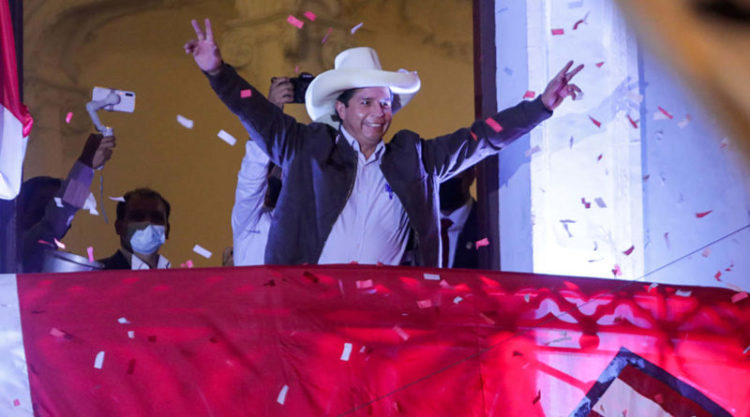
From the first moment that the right wing discovered that it was defeated in the second round of the general elections in Peru, this same racist and classist political, business and media right wing did not accept that a person from the countryside, a rural teacher, Quechua-speaking and wearing a sombrero should be president. Even though Pedro Castillo did not jeopardize the economic interests of the business class and has a neoliberal continuity line, they did not accept that a president with these characteristics should have won the elections; classism and racism is the combination to give life to a coup.
The declaration of war was made by Keiko and López Aliaga on the same day of the second round, when they saw that they had been defeated. The coup carried out maneuver after maneuver from day one; they knocked on the doors of the OAS, the Armed Forces barracks, and even tried to take the election results to court.
Then the offensive continued in Congress. In 15 months, the reactionary benches focused on questioning, censuring the ministers, and seeking Pedro Castillo’s downfall by promoting two failed impeachment attempts. They have turned Congress into a trench in the service of power groups and corruption, pushing back the referendum reforms, with anti-democratic counter-reforms, even restricting the right to a referendum for a constituent assembly, protecting the corrupt, doing and undoing as they please at a time of crisis and great need. This Congress works by turning its back on the workers and the people.
The Castillo government, soon after taking office, lost its political direction and, faced with the choice between relying on organization and mobilization to advance the process of change or adapting to the regime, took the latter path, prioritizing continuity in order to survive. Moreover, the issue of corruption in Castillo’s entourage was a concrete fact that weakened the government. Although it was the popular vote and a program of change that brought Castillo to power, he was never really a leftist.
After two impeachment attempts by the right wing, on December 7, a third vacancy motion was discussed in Congress. At the same time, the right wing had a plan B, which was the suspension from office for five years through an indictment that the Public Prosecutor’s Office filed against Castillo for treason to the country, which also the constitutional complaints commission of Congress quickly gave it course so that it could be discussed in the plenary next week.
In the morning, Castillo made a misstep that cost him the presidency: a desperate measure without force, without articulating even with his cabinet (within 30 minutes of announcing the dissolution of Congress, 10 of his ministers resigned). Then different sectors were speaking out, leaving Castillo more and more alone and weakened. The only thing that his attempt succeeded in doing was to give the right wing a chance for Parliament to achieve the coup it so desperately wanted. Castillo was impeached and detained at City Hall.
Dina Baluarte, the vice president who had already distanced herself from Castillo by resigning from the cabinet, took office. In a political calculation, she sought an agreement with the liberal sectors and decided to take over as her replacement. In her first statements, she called for national unity and a governing pact with the fascist right, and said nothing about a general election process. The tsunami has not yet passed, the political chessboard is being rearranged and the different sectors are processing this new situation.
Our politics and the construction of a strategic tool
It is clear that there is no consistent leadership, no break with the model that would encourage mobilization and struggle for the demands of different social actors. This is a long-term task to be solved. In the meantime, we should seek to promote a large popular and constituent bloc.
The authoritarian right wants to cling to Congress. We cannot allow this, but go out to the streets and call for an early election. But they cannot be held with the same current rules, and given the lack of political representation we are experiencing, changes or reforms in electoral regulations are needed to ensure that they are more democratic and participatory.
At the same time, the Peruvian people, and especially the most vulnerable, are experiencing very critical economic times in popular households – and this crisis will certainly worsen and have an even greater impact. An emergency plan is needed that begins by imposing taxes on excessive mining profits, ending tax evasion and exonerations, collecting debts from companies that owe millions to the state, etc. And finally, as a fundamental solution to the crisis, on the day of the general elections, incorporate a second ballot box so that the people can decide on the need for a Constituent Assembly.
To achieve these demands requires organization and struggle, fundamental tools that the workers and the people have, and today, more than ever, we must succeed in registering New Peru with the JNE on the road to building a reference point of the left.