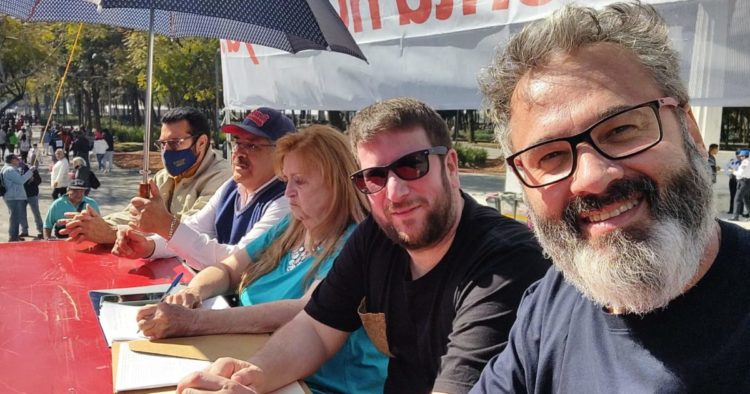
There is a reorganization of the revolutionary left in Mexico, intertwined with the desire to restructure the popular and trade union movements in the country, which can – and should – be looked at with attention and interest by those groups that claim to be internationalist, Marxist and revolutionary, especially Latin American ones. In the last days of January, Mexico City hosted the congress that marked the fusion of two Marxist and revolutionary organizations, bringing together about 200 militant from all over the country. Both already worked together in practice, but they proposed to seal agreements and principles, aiming at the political strengthening of this axis of ideas and actions: the Organización Nacional del Poder Popular (MSPP) and the Coordinadora Socialista Revolucionaria (CSR). The first with a national structure, whose greatest strength is in Chiapas, the southern region of Mexico where Zapatism was born, and the second linked to the Fourth International. United, they formed the Socialist Movement of Popular Power (MSPP). In the same period, the Forum of the International Struggle Against the Right took place, in which strategies to contain the advance of the extreme right in the world were discussed.
The Socialist Left Movement (MES) was one of the organizations that participated in the events, with its leader Roberto Robaina as one of the guests, together with the Spanish congressman and anti-capitalist activist Miguel Urban and the feminist activist Heather Dashner, from Mexico. It became evident there, as a common perception to all, the need to take advantage of the political moment to restructure the class struggles and the workers’ movements, not only in Mexico, but throughout the world, strengthening the workers’ organizations that have been so massacred by the logic of neoliberal capitalism.
Mexico was the precursor to the electoral setbacks suffered by the far right in America in securing the victory of Andrés Manuel López Obrador (AMLO) in 2018. After decades under the domination of the reactionary oligarchic bourgeoisies, represented by the Institutional Revolutionary Party (PRI), the National Action Party (PAN) and the Party of Democratic Revolution (PRD), Mexicans managed to elect a progressive government, establishing a new relation of political forces that allows a reorganization of the masses to the satisfaction of the demands of the working classes. We have seen, in the sequence of Latin American electoral processes, important popular uprisings, such as in Chile, where the population took to the streets and promoted, in 2019, the so-called social revolts and, three years later, gave the former student leader Gabriel Boric the presidential mandate. In Colombia, the protests of 2021 were a reaction to the announcement of reforms by then-President Ivan Duque that harmed the poorest. Last year, the population of the Andean country brought to power the leftist candidate, former M-19 guerrilla Gustavo Petro. All these moves preceded another electoral failure of the extreme right: Lula’s victory over Bolsonaro in Brazil.
Hopes without illusions in the face of new governments
But in all these processes, it is important not to settle into illusions. And this awareness of the real configuration of the governments provides the basis for the struggle that the new Mexican MSPP intends to establish. Like none of these governments, Obrador is not characterized, among MSPP members, as an anti-capitalist government. The leaders who seek an independent unionism in the country – Mexican unions, as a rule, have been co-opted by the governments – also do not recognize his mandate in this way, nor do they see in him a supporter of independent unionism. However, the defeat of the PRI, PAN and PRD and the aforementioned changes in the political panorama in Latin America bring a breath of hope for better days ahead, with no less need for struggle and organization. One cannot equate AMLO’s government with previous ones, closely linked to the bourgeois oligarchies and corruption.
In Mexico, measures such as the establishment of a US$300 aid to citizens over 65 years of age, the strengthening of the local currency, which allowed the Mexican peso to appreciate by 20% against the dollar, and the intention to reformulate the energy sector, were fundamental for Obrador to set in motion what he called the government of the 4th Transformation (4T). The first three would be linked to the country’s independence process in 1821, the reforms throughout the 19th century, and the Mexican Revolution (1910-1917), in which the movement led by Emiliano Zapata defeated the dictatorship of Porfirio Diaz.
But there is much to be done to actually have sustainable economic development for the working classes, the most affected by the recent capitalist crisis, which has been going on since 2008 and has worsened with the reflexes of climate change – persistent droughts or floods with damage to agriculture – with the Covid-19 pandemic, which affected service sectors all over the world, and with the war in Ukraine, which promoted instability in the energy sector.
There are major limitations and contradictions in the Obradorist program. Among them, maintaining the North American Free Trade Agreement (NAFTA) with the United States and Canada, incorporating representatives of the oligarchy in its ranks, not carrying out expropriations, maintaining the payment of the public debt, and respecting mining contracts and concessions, from which labor conflicts derive. In other words, key aspects of the neoliberal economy were maintained. Obrero also did not take off the paper measures such as the taxation of large fortunes and the clampdown on the violence imposed by drug trafficking on peasant and indigenous communities.
It must be clear that the Morena, Obrador’s party, is formed by various classes and has a bourgeois orientation, whose efforts are limited to “humanizing” capitalism a little, which generates a good impression on the masses and electoral gains. The currents further to the left already subordinate themselves to this logic under the argument of unity to govern. So, structurally, nothing changes, even if it is not a government comparable to the PRI. In good measure, this configuration is similar to the Lula government in Brazil. Similar contradictions with local nuances.
In both countries it is the urgent task of the revolutionary left to strengthen the social movements both from the organizational and political point of view, guaranteeing strength, unity and political independence from the state. This independence is urgent, because we have observed in Mexico a cooling down of the movements after Obrador’s victory, just as we saw in Brazil in the early 2000s with the first mandate of Lula. It is not possible to fight the extreme right without strengthening social and workers’ organizations.
The MSPP wants to reinvigorate the class struggle and make sure that agendas dear to the social movements are not swallowed by the conciliatory discourse and the discourse of governability with the bourgeoisie. So, it is a restructuring to assert the commitment to the end of violence and the militarization process in the country, with the nationalization of strategic sectors, like energy and transport, the institution of universal basic income for people over 18 years old, based on a tax reform in which the rich pay more, the valorization of salaries, the reduction of the working week to 30 or 35 hours, among other urgent demands.
For an independent trade unionism
For more than four decades, Mexico has lived through the effects of the neoliberal policies dictated by multinationals, the World Bank, and the International Monetary Fund. These are economic effects, but above all cultural and social. Many privatizations and weakening of the state-owned companies, which have been around 1,200 companies. Trade unionism, of course, has gone into crisis, suffering severe attacks on workers’ conquests that date back to the Mexican Revolution (1910-1917). Mexico was the first country in Latin America to constitutionally grant all labor rights, such as time off, minimum wage, vacation, social security, etc.
The defeat of the PRI fortified the need to restructure the independent labor movement. Trade unions and labor lawyers pleaded for a Reform aligned with International Labor Organization (ILO) agreements and that would secure historic rights. In 2019, the Labor Reform was approved. It did not cover everything that interested the trade union movement, but it advanced as it provided for elections – with secret ballot and in ballot boxes – for union leaders, representatives and committees, as well as gender equity in the occupation of positions in unions.
“From the legal point of view, all possibilities are open for a union reorganization to form unions independent from the government”, says Raul Lescas, director of the Political Training Institute of the National Confederation of Independent Unions of Mexico, the entity that is leading this new attempt of union reorganization without the domination of the government, parties, employers or any forces other than the workers themselves, who currently represent around 40 million people in Mexico.
The challenge of an independent trade union movement is there. It is a historical challenge that goes back to the end of the 1950s, when there was the struggle for the democratization of the railway workers union, at the cost of more than 10,000 prisoners among the category alone. In San Luis Potosí, for more than two decades, the Independent Union of Workers has resisted to have its union freedom respected.
There is another no less important front in this union restructuring proposed by the Confederation: to increase the unionization rate, which currently doesn’t reach 10% of the employed population in Mexico, and is a reflection of the actions of the so-called “pelegos”, that for decades have been corporatizing with the governments and subjecting the working class to the interests of those who exploit it.
Because of this, political training has gained priority in the restructuring. Lescas points out that it is through this political formation that it will be possible to form leaders among the workers who will be better able to defend union autonomy and avoid repeating the mistakes of the past:
“This restructuring passes through disorganizing the pelegos unions and organizing the disorganized workers. And the political formation has to go parallel to this restructuring. The basis of the transformation of our country has to come from below, not from above. It has to come from the workers in the countryside and in the cities and in the services.”