Argentina, 2023
The beautiful movie “Argentina, 1985” that deals with the justice of the transition to democracy after one of the bloodiest dictatorships on the planet was among the main foreign films nominated for the Oscar.
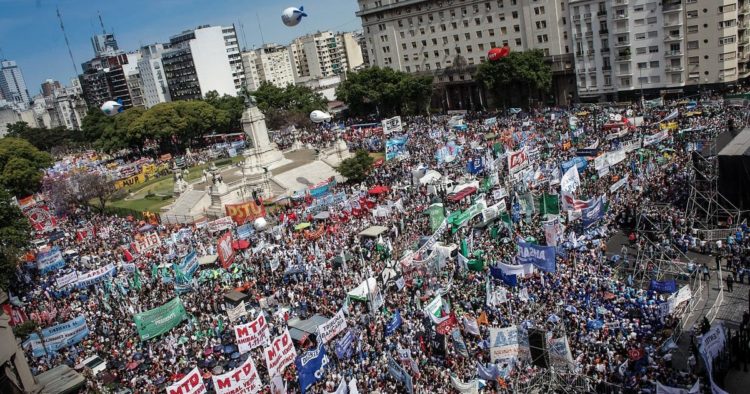
It was impossible not to remember it when I arrived in Buenos Aires, invited to a series of events and meetings, accompanying Eric Toussaint. I found myself in an Argentina that bears remarkable traces of memory, especially also because I arrived the week after the March 24th demonstration, a date that remembers the fight against dictatorship and the people killed by State terrorism. In the last few days, as I was writing, new events – such as the rise of the dollar and statements by Alberto Fernandez, who like Macri, has dropped out of the race for the presidency – only aggravated the situation.
And of course, Argentina is one of the main countries of the continent, and therefore always important for Brazil and Latin America as a whole. So, for the record, I would like to point out some of the things I was able to notice and witness. It is worth saying that, as I was closing this article, Argentina was once again in an exchange rate race, motivated by the action of speculators and a shortage of dollars.
A government on the road to failure
Alberto Fernandez’s government is the result of a coalition between the different wings of Peronism, in which Cristina, his vice-president, expresses the sector that wants to vocalize more “popular demands”. The government had a broad electoral victory, in the wake of the failure of the adjustment model of Macri’s previous government. In this framework, a deep political crisis is combined with a recurrent economic crisis.
The three most important events of the last period were Alberto’s visit to Biden, the withdrawal of Mauricio Macri and Alberto Fernandez themselves from running for president in the election scheduled for October, and the new currency race that is being rehearsed.
In the last few weeks the parallel dollar, called “dollar blue”, has skyrocketed, reaching almost 500 pesos and alarming the country.
We are in an election year, and the Argentine tradition is of a “broad” pre-campaign. Therefore, we can say that the election campaign already dominates the overall debate. There is, however, an unusual element: this is the most unpredictable election in the last 20 years.
This means that the very definition of the candidates is still early. There is a dispute within the country’s two main political coalitions, Frente de Todxs and Juntos por el Cambio – both in crises that result in exposed fractures. Macri has decided not to be a candidate, fearful of a vexation, because in the popular memory the failure of his government is still fresh. In the same vein, as the crisis worsens once again, Alberto Fernandez, via a video posted on social networks, also announces that he will no longer be a candidate.
Argentina today has direct relations with the International Monetary Fund (IMF), and is even more dependent through the latest agreement, closed in 2021. The meeting with Biden and Githa Gopinath, chief economist of the World Bank, only indicated more subservience, in a scenario in which the United States needs to dispute influence in the region in the face of China’s political and commercial emergency.
The IMF agreement only reinforces dependence, with huge debt ties and various speculative attacks by vulture funds, in disputes that have been going on for years.
The real Argentina, in the neighborhoods and territories, is marked by a terrible scenario of poverty. More than 40% of the country is already under poverty conditions. Inflation is close to 110% per year, eroding wage gains and leading to constant markdowns on supermarket shelves.
The dispute in the Frente de Todos (FdT) is between the current super-minister, Sergio Massa, a trusted man of the US embassy, Cristina Kichner, who is fighting against her electoral proscription, and the current ambassador to Brazil, Daniel Scioli.
The Right wing and the inability to govern
In the crisis of the FdT government, the right wing is favored, capitalizing on the social malaise for a majority opposition vote. Although the polls are incipient, the favoritism lies with the camp that orbits around the Juntos por el Cambio (JxC) coalition.
However, even in the favored camp the scenario is far from stable. Macri’s withdrawal is a symptom. The crisis is spreading throughout Macri’s party, especially in the Buenos Aires city election, where Larreta has broken the agreed schedule of preliminary polls (Paso). Larreta seeks to use the good image in Caba, just as Macri did before he became president, to boost his plans to reach the Casa Rosada. The issue is that the other sector, with a lot of strength, is linked to the Minister of Public Security, Patricia Bulrich, who has a “harder” program on the right.
In this scenario, some hypotheses arise, within the uncertain picture: Javier Milei’s irruption takes the dispute further to the right, and he himself could reach the second round and hinder JxC’s plans. An improbable victory is not ruled out, even if it would be in an unusual scenario.
In any case, faced with the acute crisis, a new right-wing government will have to ensure a tougher adjustment, revoking, for example, transportation and electricity subsidies; or even eliminating the plans, “work” benefits paid to the unemployed, who are organized by the piqueteros social movement. A devaluation of wages would also be in the flight plan of a more right-wing government. This would open up the hypothesis of the clash of trains: reinforced adjustment versus the reserves of the labor movement
The Milei Risk
The other phenomenon that marks the conjuncture in this pre-election period is the emergence of Javier Milei, with mass weight and with a privileged position in the polls (he has between 16 and 20%). Defender of the dictatorship and of an ultraliberal vision, referenced in the Pinochetist model, the politician is the expression of the extreme right in Argentina.
Starting with his ultraliberal preaching – based on the theorist Murray Rothbard (which some have unhappily defined as paleoliberal or anarcho-capitalist) -, he has been condensing with the underground agenda of the Argentine extreme right, with figures such as Bussy in Tucumán and Olmedo in Salta.
Milei gained notoriety by presenting himself as an eccentric economist, with his folkloric hairdo, on television and in the theater, attacking Keynes and Peronism. He gained space in the 2021 election, and ended up entering with great force in open TV, which helped inflate his figure to postulate a more neoliberal and right-wing agenda.
The main flags are those that bring together the reaction to the picketing movement and the advancement of women’s struggles and LGBTQIA+ rights, as in neutral language; and ultraliberal measures capable of making Paulo Guedes a “moderate”, such is the voracity of the adjustment. On the economic front, he advocates the absolute dollarization of Argentina’s economy and the immediate privatization of all health and education.
In addition to providing himself a vector to the right, boosting a conservative common sense in mass sectors – a phenomenon we know from Bolsonaro – involves a “bronca vote” mixed with conservative values, and forces the action of extreme right-wing groups. Marginal groups in the political sphere, but which act as a shock force, amplifying the volume of the extreme right and its methods. This was seen in the case of the attack against Cristina and even in attacks against the headquarters of left-wing organizations. One of the most emblematic cases was the attack in La Plata against the headquarters of IS (a leftist party member of Fitu), which was filmed and disseminated in social networks.
Given the general crisis, Milei’s presence in the second round cannot be ruled out. And if the general crisis deepens, even if he is not a favorite, an electoral victory would be an unlikely, yet possible, hypothesis.
“Targeting Argentina”
One cannot separate the Brazilian political process from its relations within South America, in which Argentina is perhaps its closest neighbor. The developing contradictions of Argentine capitalism have and will have enormous implications for Brazilian social life. Issues like deindustrialization, the weight of agro, extractivism and the place of the military in political life directly impact both countries.
And we can affirm that the workers’ movement in both countries, as well as in Mexico, is a giant that, when it awakens, moves the tectonic plates of society. It was like this in the rise of the Cordobazo, 1969, in Argentina, or the great strikes of the ABC (1979-84) in Brazil.
Milei’s electoral irruption recalls Bolsonaro.
We need solidarity with the struggles of the Argentine people, their organizations, accompanying the development of the radical left, which has as its future to face the class conciliation and the attacks coming from the right and the extreme right. The contradictions of Fitu, whether due to its fragmentation or its still sectarian vision, can only be overcome in the development of the class struggle itself and its experiences.
The struggle of the picketers, which involves hundreds of thousands of people in poor neighborhoods throughout Argentina, is a laboratory for the capacity of the different organizations to expand their influence and rooting.
The failure of the model tied to the IMF – and the burning issue of debt – must become a broad movement of mass rejection of the Fund’s dictates, as a condition for breaking the current model that unites the parties of the ruling class.
The next two years in Argentina will be crucial for the course of the relation of forces in the continent as a whole.
As with “Argentina, 1985”, we can take lessons from the reserves of democratic struggle in Argentina, which can generate a scenario of constant confrontations, in the face of a government that wants to expand the scope of state repression. Miremos a Argentina.