Politics has reached its pure form, the extreme nature preached by Schmitt, the friend-enemy relationship. An autopoietic result of the system that produces successive polarizations, from the performances in everyday life to the functioning of representative democracy. The algorithmic system, founded on the binary positive-negative language, 0-1, ends up absolutizing this route, eliminating any different or alternative form. Politics, like the militancy of a community at an event, finds its energy in creating an opportune enemy, to align the world. There is no middle ground.
The theory lies in the fact that polarization leads to successive scenarios of catastrophic deadlocks between the reference poles, the impossibility of unloading the system, especially in the field of politics. The advent of computer networks and artificial intelligence has taken to the extreme the functioning of a system of control, not only in the dynamics of biopolitics, but above all in necropolitics; the goal is to eliminate the enemy. The elimination ranges from the physical violence of gangs of hired killers to the symbolic violence of the media and related networks that portray the new terrorist in the figure of social fighters. Politics is not expressed in the presentation of proposals, programs, but in the ability to destroy the messenger; to attack, not the word, to tear out the word, the logos, of the other. Disqualification, hatred and fakenews predominate in the networks.
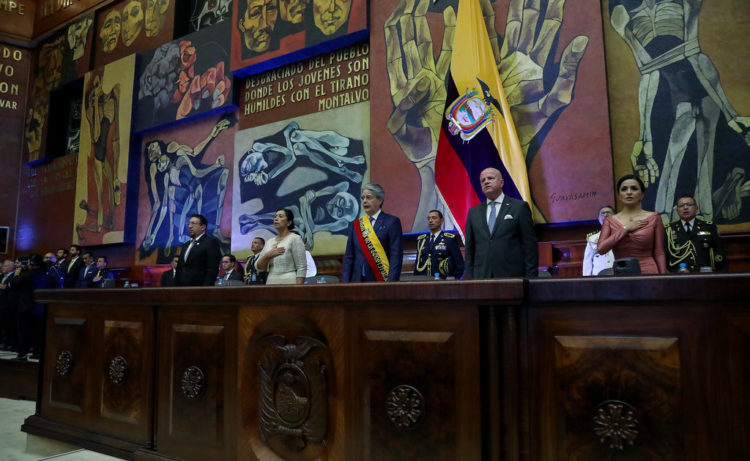
The contradictions between the Lasso government and the opposition, led by the UNES-PSC alliance, polarize the political scene and seem to close the possibility of an autonomous position in defense of the country’s interests. The failure of the three projects that have governed leads to a political crisis that starts from the fact that none of them has the strength to impose its hegemony and ends in political impasses with successive attempts to exit. Lasso tried to gain space with the Popular Consultation, but was defeated. The UNES-PSC opposition countered with the impeachment trial, which became a space to negotiate the distribution of power and the economy.
The impeachment trial was stripped by both sides of its democratic content, the assessment of the Lasso government’s responsibilities for the economic and political crisis and the risk of a narco-state. The Gran Padrino case, which was the trigger for the impeachment trial and which showed the links between the regime and the economic and political power with international mafias and organized crime, has disappeared. It has been downgraded to a criminal case involving FLOPEC’s business dealings and the capture of votes by the government or the Christian Social Correctist opposition in order to form their own majorities.
Amidst the confusion and trial negotiations, Lasso’s authoritarian and militaristic government, with Decree 730, imposed a project of State terrorism, which was rejected in the Popular Consultation and which, although it attacks the local gangs, does not show any form of confrontation with the local gangs, does not show the means to confront the big local and transnational powers and, above all, superimposes the war against organized crime with the condemnation as terrorist acts against those who oppose extractivism, the new privatization processes or the protofascist policies of the State.
Therefore, it is essential to make precise decisions, starting with supporting the impeachment and Lasso’s departure, which is not a definitive solution, but can open the door to a political reordering that takes into account the needs of the population. Any hesitation on this issue means renouncing a democratic solution to the country’s crisis.
The responsibility lies with the Pachakutik Movement, which was constituted by the citizens as the second political force in the February 5 elections and which has the possibility of promoting its own politics. Therein lies the paradox of the KP. A polarized system opens fissures that are structurally weak, but have the potential to bring down the foundation. It is not a matter of seeking the middle ground, but of re-establishing the vision of totality, for anti-systemic responses, confronting the capitalist-colonial-patriarchal triple domination.
In terms of political doctrine, it is no longer enough to deal with inter-bourgeois contradictions or the bourgeois-oligarchic struggle to define the main enemy, because the separation between good and evil, between truth and lies, cuts across the totality, so that it can quickly slide into a strategy of the lesser evil, which blocks the capacity for a project of one’s own.
The vote on the continuation of the trial shows the tendency of a political stalemate. The approval gets 88 votes, which allows the process to continue, apart from the regime’s procedural obstruction maneuvers; but the opposition lacks four crucial votes to resolve Lasso’s impeachment. This majority could also allow the opposition to take control of the Assembly.
Those four votes are among the 11 absent members of the PK Assembly, which define the balance of power. The PK could put politics back on track and reestablish the direction that Lasso should go. Trapped in the squabbles and accusations between the Correistas and Lassoists, he will find it difficult to find an autonomous path.
The resulting scenario in the country could be the persistence of a CREO-controlled, albeit weakened, executive and an opposition-controlled parliament. The situation would not change much if Lasso leaves and Vice President Borrero remains, perhaps opening the door for greater PSC influence.
The question is how to break this false polarization, how to put the problems affecting the country and the interests of the people at the center?
When there is an impasse at the top, the word must return to the sovereign; facing the limits of liberal democracy, it is possible to promote processes of community and social democracy, to strengthen the seeds of solidarity and respect for mother nature in the economy, to promote strategies of social security in the face of violence. We can gather the energy of the struggles and resistances of the peoples against mining and in defense of life, put the 10 points of the uprising as a basis for agreements. From there we can promote a Front that agrees on a Democratic National Program that unites the forces that aspire to a sovereign country, free of violence and corruption.