Petro’s election created a wave of enthusiasm throughout Latin America. For the first time, the Left took over the government, displacing the traditional parties: uribism and the liberals. It also meant closing the door on the uribist state that President Duque represented, a regime of the landowning oligarchy, closely linked to self-defense groups, paramilitaries that were part of a policy of state terrorism. Now, the president is a former member of the M19 military guerrillas, a veteran of militant actions and with a Marxist background.
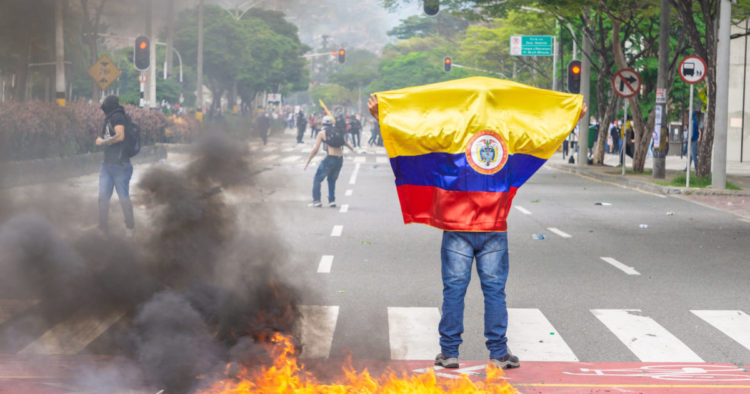
This victorious electoral result was the product of the great days of strikes and mobilization, which were in fact an inconclusive rebellion, which won a victory against Duque’s tax reform. We say “inconclusive” because the indigenous and popular strikes and mobilizations continued afterwards against his government and his repression. However, the government managed to avoid its downfall due to intense repression, the exhaustion of the mobilization itself, and the absence of a leadership that could build an alternative power.
The victory of the Leftist candidacy represented by Gustavo Petro (Pacto Histórico) and Francia Márquez (Soy Porque Somos), an indigenous and Black leader from Valle del Cauca, in the June 19 elections can only be explained by the previous action of the mobilized workers, youth and indigenous people.
As in the vast majority of elections in Latin America (with the exception of Mexico), the winning government did not have a parliamentary majority. So once in power, Petro called for “national unity for peace,” made a pact with Gaviria’s Liberal Party, and formed a cabinet that was called the cabinet of national consensus. In any case, with this cabinet, he went further than the Lula or Boric governments did with their alliances. He dismissed some 70 generals and military commanders and managed, within days of taking office, to vote a progressive tax reform that taxed large fortunes.
Petro and its “balconazo”
After nine months of a government in agreement with the Liberal Party, in which health reform, other social reforms, and land reform to settle ex-combatants and landless sectors could not be accomplished, Petro decided to make a major change in the ministerial cabinet, effectively breaking the pact with the Liberal Party. He replaced a large part of the cabinet, appointing ministers who were close to him or members of his party. On February 14, he had already announced this before Congress, when he said that if the social reforms (health, labor and social security) were not pushed through, “there could be a revolution in the country if they are cut…”.
On May 1st, Petro holds what has been called a “balconazo” of the government house, located in the Plaza de las Armas, which gathered thousands of people (the “azo” was born precisely in Bogotá, in 1948, when the Bogotazo took place, a popular rebellion after the assassination of popular leader Gaitán by the conservative right wing). On International Workers’ Day, Petro gave a rather blunt speech.
“The people cannot sleep. It is not enough to win at the ballot box, social change implies a permanent struggle and the permanent struggle occurs with a mobilized people and at the head of this mobilized people must be the youth, the workers, the working class. The attempt to restrict the reforms can lead to a revolution.”
That, according to Petro, would be a waste of time, and that’s why he said he expects the workers to fight. “We will not go one meter beyond where the people don’t want us to go. Nor will we go one meter short of where the people want us to go. We will go as far as the decisions of the people want us to go.” And he insisted that the government needs the power of the people. “I wonder if the time has come for the working people to make decisions, no longer to simply protest, but to decide to govern, a government that has to be of majorities, of a mobilized people.” Referring to Agrarian Reform, Petro said that “the sector of the privileged does not offer us the land voluntarily,” so the government has to go after the land if it is not offered to them.
His vice president, Francia Marquez, spoke similarly that day in Cali. “Today (May 1), the Colombian people showed you who is in charge of this country. The Colombian people are in charge, the Colombian peasantry is in charge, the Afro-descendants, the peasants are in charge, the youth, the youth of Cali are in charge, and I am not afraid to say here that the ‘front line’ is alive.”
How far will Petro get in Colombia?
Words are an important part of politics because they open a horizon; in particular, Petro, in his speech, summons the people and the workers. Although words say a lot and have their meaning, they are not the same as deeds, which are the product of what is said and also what is done. But it is clear that with this speech Petro is distancing himself from the leadership of the old Liberal Party and looking for new horizons.
He is also an example for us Brazilians, which contrasts as night and day with what Lula is doing in Brazil. How far will he go? We don’t know. In his own speech, Petro said that he is not closed to dialogue and consultation, although it is clear that he intends to do so in a new plan with a government in which the Historical Pact has hegemony in the ministries. It will depend on the relationship that is established between the government and the mass movement on the one hand, and how strongly the right wing reacts on the other. And the million dollar question is whether, after this speech, a form of popular power will be established, that is, if organisms will be created to discuss how to carry these reforms forward and whether Petro and Marquez will encourage them.
While maintaining organizational independence from the government, it seems to us that this is the path along which the left and the sectors that emerged from the 2021 mobilization should be oriented. Promote new workers’ and popular power organizations that support the reforms, in a process that can be extended over time. Of course, this is a long view. What is very necessary is to establish a dialogue between the Latin American and Colombian anti-capitalist vanguard to not let this moment pass and to decide how to act to help advance the process towards a break with the dominant economic power upper bourgeoisie. Much will depend on whether the force shown in the streets will do more than it did in 2021, if they wake up and organize to carry these reforms forward and cross the Rubicon.