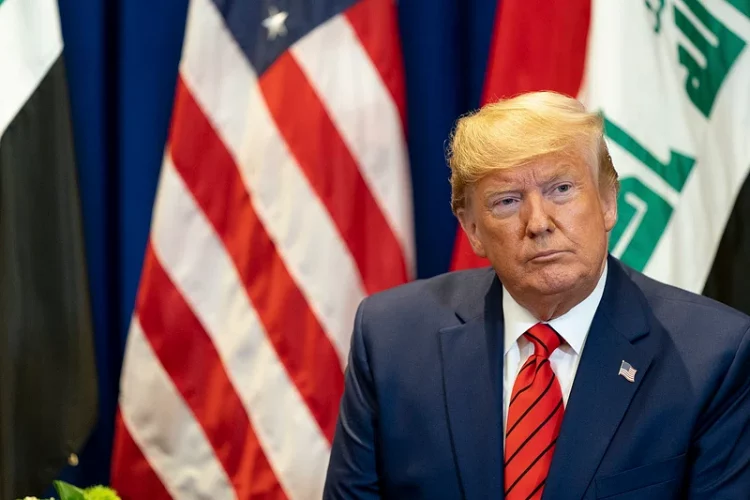
Politics and performance go hand in hand when it comes to Donald Trump, who embodies a neofascist project of power. But the past few days have been difficult for the president of the United States in his ongoing effort to project strength.
Three recent developments have damaged his administration: the October 18 demonstrations (No Kings), the federal shutdown, and the November 4 elections. The first two events were unprecedented in scale: No Kings became the largest single day of protests in U.S. history, and the 43-day shutdown was the longest ever recorded. The demonstrations revealed a broad social majority opposed to Trump. Even if they were not especially disruptive in form, they brought millions of people to the streets, shifted the political consciousness of average Americans, and reverberated across international news outlets. The shutdown, meanwhile, intensified negative perceptions about the direction of the country and the state of the economy. It led to layoffs, service delays, and disruptions across federal programs, including, most notably, the food assistance program that serves 40 million low-income Americans.
Finally, the elections were a clear defeat for the Republican Party. This included not only Zohran Mamdani’s resounding victory in New York City, but also the gubernatorial results in New Jersey and Virginia. In California, voters approved a ballot measure reorganizing the state’s electoral districts in a way that favors Democrats in the upcoming midterms, countering Republican gerrymanders in Texas, North Carolina, and Missouri. Trump himself acknowledged that the polls punished his party.
With less than one year in office and after a frenetic start, things now appear more complicated for the president and his MAGA movement. Attempts to impose authoritarian measures were floated after the assassination of Charlie Kirk on September 10 but ultimately did not materialize. Even so, a series of ultrareactionary initiatives continues to unfold with uncertain outcomes, from federal intervention in Democratic-run cities to deport immigrants to ideological crackdowns on universities and groups labeled “antifascist.” Internationally, the infamous spectacle surrounding the announcement of “peace” in Gaza exposed deep inconsistencies, and the administration’s recent pivot toward Latin America is generating political costs amid criminal attacks on boats in international waters and the growing threat of war in Venezuela. Meanwhile, newly released documents in the Jeffrey Epstein case could prove damaging for Trump.
As Neal Meyer recently argued (https://www.left-notes.com/p/trump-and-maga-are-down-but-not-out), the MAGA movement is taking hits, but it will not collapse on its own. One of the defining contradictions of this political moment is the Democratic Party establishment’s inability to present any real solutions to the country’s crisis.
This is why attention should be paid to what is happening outside that establishment, including in electoral politics. On November 4, it wasn’t only Zohran Mamdani in New York who won and surprised the political world. In Seattle — the largest city in Washington State —, Katie Wilson secured victory in the mayoral race. Like Mamdani, she is a member of the Democratic Socialists of America (DSA) and defeated the incumbent Democratic mayor. In Minneapolis, the city of George Floyd, DSA candidate Omar Fateh won 44 percent of the vote and finished second. Multiple DSA members won seats on city councils, a pattern also seen in major cities like Atlanta (Georgia) and Detroit (Michigan), as well as in smaller municipalities. In Portland (Oregon), at the end of 2024, the DSA won one-third of the seats on the City Council.
These developments point to real political space for a radical left in the United States, even as the conservative pressure of the two-party system continues to push independents toward cooptation. To seize the current opening and build toward Trump’s defeat, this pole — whose most advanced expression is the DSA — must be strengthened.
The DSA, for its part, now governing cities for the first time, faces the challenge of acting like a party without actually being one. Its central task is to help build the broadest possible anti-Trump movement in the United States, including toward the 2026 elections. At the same time, democratic socialists must refine their own strategy for political power and their program; without these, even the most dynamic popular movements ultimately become absorbed by the machinery of the capitalist state and its institutions.
The continued growth of a radical left project in the heart of global imperialism is, without question, what most terrifies the far right and the billionaire class. The success of Zohran Mamdani’s administration, the strengthening of social struggles, and the consolidation of a political project grounded in class independence and radicalism — these are the forces fueling the hopes of those committed to defeating Trump and building a better future.